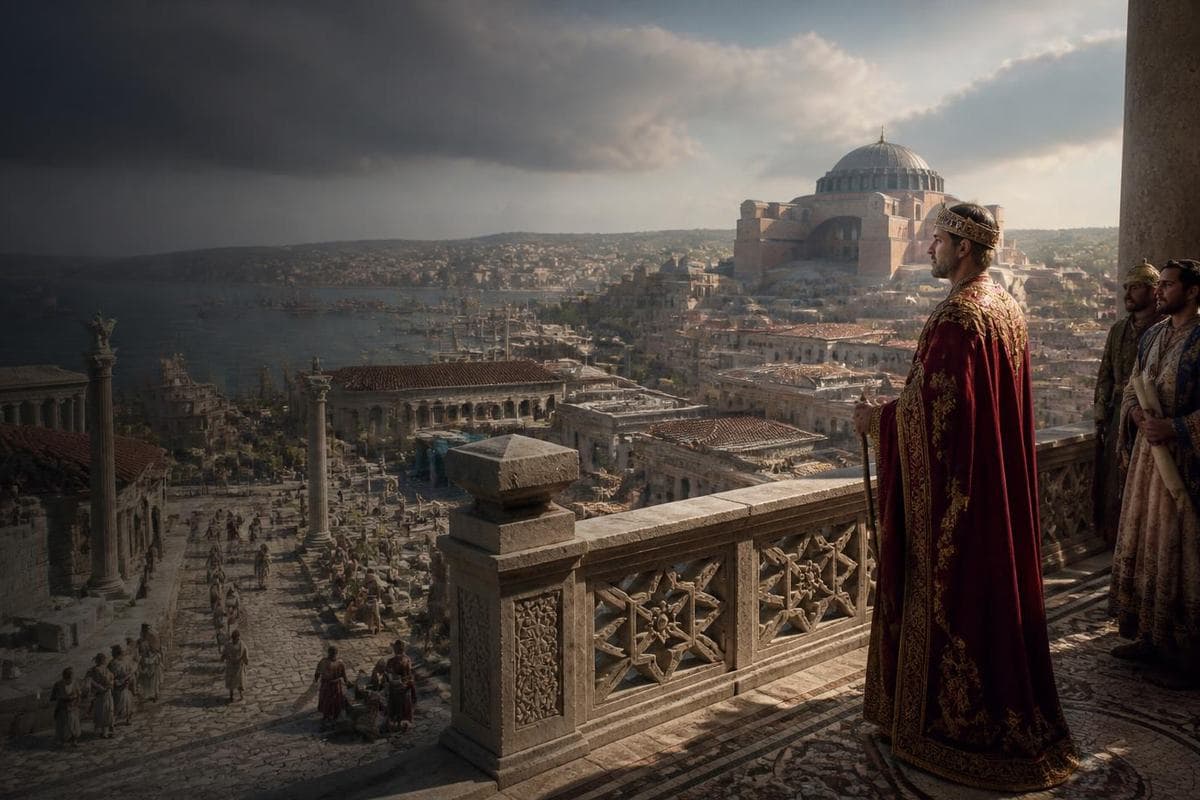
527–565 CE
The Reign of Justinian I
Overview
The reign of Emperor Justinian I, spanning from 527 to 565 CE, marks one of the most significant and grand periods in the history of the Byzantine Empire. Succeeding his uncle Justin I, Justinian's primary ambition was to achieve a "renovatio imperii," meaning "restoration of the Empire," aiming to reclaim the territories of the former Western Roman Empire.
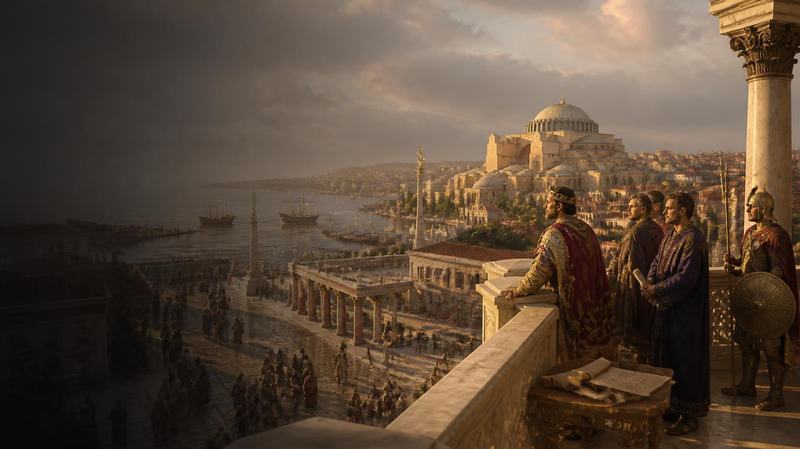
During this era, under the leadership of his general Belisarius, the Byzantine Empire successfully reconquered the Vandal Kingdom in North Africa and the Ostrogothic Kingdom, bringing Dalmatia, Sicily, Italy, and Rome back under imperial control. Additionally, the southern part of the Iberian Peninsula was reincorporated, establishing the province of Spania. Beyond his military successes, Justinian is widely recognized for the Corpus Iuris Civilis, a comprehensive codification of Roman law that laid foundational principles for many modern European legal systems. This period also saw significant internal challenges, including the devastating The Day Constantinople Burned: The Nika Riots of 532 and the widespread impact of the Justinianic Plague.
Key Events
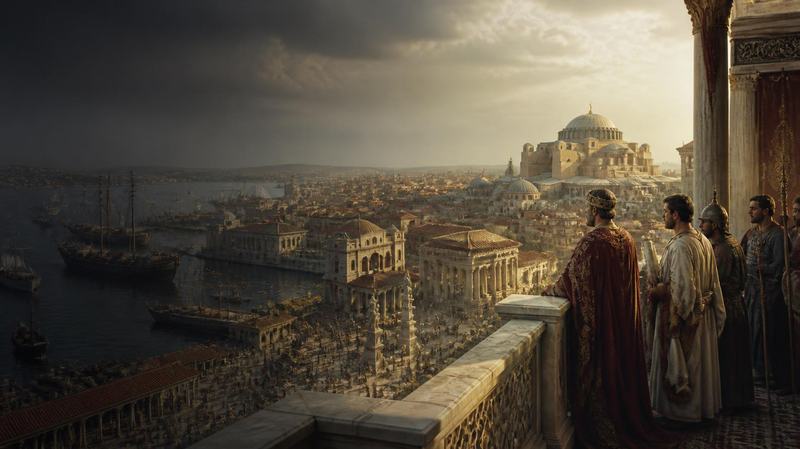
- 532 — The Nika Riots, a week-long and exceptionally violent uprising, devastated much of Constantinople and led to the destruction of the earlier Hagia Sophia basilica.
- 532–537 — The construction of the current Hagia Sophia, commissioned by Emperor Justinian I, was completed by architects Anthemius of Tralles and Isidore of Miletus.
- 541–542 — The Justinianic Plague began to spread through the Byzantine Empire, reaching Constantinople in 542 CE, eventually causing widespread devastation across the Mediterranean world.
- 558 — The main dome of Hagia Sophia collapsed after a series of earthquakes, also destroying the ambon, ciborium, and altar.
- 562 — Restoration of the Hagia Sophia's dome, led by Isidore the Younger, was completed, featuring a new, higher, and lighter dome.
Related Places
Frequently asked questions
What was Emperor Justinian I's main goal during his reign?
Emperor Justinian I's primary objective was known as "renovatio imperii," which translates to "restoration of the Empire." He aimed to reclaim the lost territories of the former Western Roman Empire and restore the glory of the Roman state.
What was the Corpus Iuris Civilis?
The Corpus Iuris Civilis was a comprehensive and unified rewriting of Roman law. It was a monumental achievement during Justinian's reign that forms the basis for many modern European legal systems.
What were the Nika Riots?
The Nika Riots were a devastating week-long uprising in Constantinople in 532 CE, considered one of the most violent in the city's history. Sparked by tensions between chariot racing factions (the Blues and Greens), it evolved into a revolt against imperial rule, resulting in widespread destruction and the loss of tens of thousands of lives.
How was Hagia Sophia affected by the Nika Riots?
During the Nika Riots, the previous basilica on the site of Hagia Sophia: A Layered History was burned down and destroyed by the rioters. This destruction prompted Emperor Justinian to commission the construction of the magnificent structure that stands today.
What caused the collapse of Hagia Sophia's dome?
The main dome of Hagia Sophia: A Layered History collapsed in 558 CE, a relatively short time after its initial construction. This was due to a series of earthquakes, specifically those in 553 and 557, which caused cracks, leading to the eventual structural failure in 558.
What was the Justinianic Plague and its impact?
The Justinianic Plague was one of the earliest known major plague pandemics in history, caused by the bacterium Yersinia pestis. It began around 541 CE in the Byzantine Empire, reaching Constantinople in 542 CE, and is estimated to have caused the deaths of 25 to 100 million people across the Mediterranean world over approximately two centuries, significantly weakening the empire.
Who were the architects of Hagia Sophia?
The architects commissioned by Emperor Justinian for the construction of Hagia Sophia: A Layered History were Anthemius of Tralles, an architect and mathematician, and Isidore of Miletus, a physicist.
When was Hagia Sophia rebuilt after its dome collapsed?
After the main dome collapsed in 558 CE, Emperor Justinian immediately ordered its reconstruction. The restoration work, led by Isidore the Younger (nephew of one of the original architects), was completed in 562 CE.
Written by Istanbook Editorial Team · Last updated September 7, 2026
Sources (4)
- britannica.com — britannica.com
- wikipedia.org — wikipedia.org
- istanbultarihi.ist — istanbultarihi.ist
- worldhistory.org — worldhistory.org