Places
Süleymaniye Mosque Complex
Overview
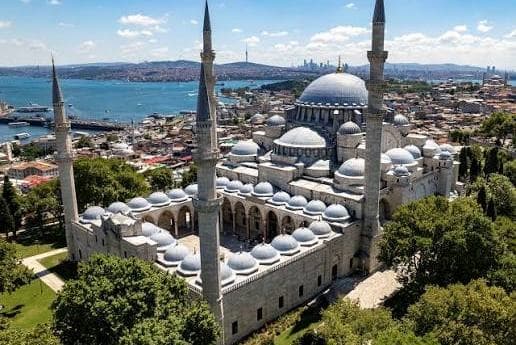
The Süleymaniye Mosque and its extensive külliye (complex) stand as a monumental testament to Ottoman imperial power and architectural prowess, gracing one of Istanbul's commanding hillsides overlooking the Golden Horn and the Bosphorus. Constructed during the zenith of the Ottoman Empire under Sultan Suleiman the Magnificent, and designed by the legendary architect Mimar Sinan, this complex is more than a place of worship; it was conceived as a self-sufficient urban institution that profoundly shaped the city's social, educational, and cultural fabric. Its imposing silhouette, a defining feature of Istanbul's historic skyline, reflects a sophisticated integration of religious and civic functions, embodying the era's vision for an ideal Ottoman city.
History
The construction of the Süleymaniye Mosque complex, commissioned by Sultan Suleiman the Magnificent, began in the mid-16th century, with its main mosque completed in 1557. This period marked the apex of the Ottoman Empire, characterized by vast territorial expansion, economic prosperity, and cultural flourishing. The complex was intended to be a lasting symbol of Suleiman's reign, rivaling the architectural grandeur of earlier Byzantine structures like the Hagia Sophia: A Layered History and projecting the Sultan's piety and immense authority. Architected by Mimar Sinan, the chief Ottoman architect, the project was a monumental undertaking that synthesized centuries of architectural knowledge with contemporary Ottoman innovation. The külliye served as a vital social infrastructure, encompassing numerous facilities beyond the mosque itself, including madrasas (theological schools), an imaret (public soup kitchen), a darüşşifa (hospital), a hamam (bathhouse), a library, and shops. These institutions provided essential services to the city's inhabitants, from education and healthcare to charity and commerce, contributing significantly to the life of Ottoman Istanbul. The complex's establishment on one of the city's historic hills not only offered panoramic views but also strategically positioned it as a dominant landmark, symbolically reinforcing the Ottoman presence and influence over the urban landscape.
Architecture
The Süleymaniye Mosque exemplifies the classical Ottoman architectural style, characterized by its harmonious proportions, spatial grandeur, and structural ingenuity, largely attributed to Mimar Sinan. The mosque's design directly references and, in many aspects, seeks to surpass the Hagia Sophia: A Layered History, particularly in its ambitious dome, which measures approximately 27.5 meters (90 feet) in diameter and rises over 50 meters (164 feet) from the ground. This central dome is supported by two semi-domes along the qibla (direction of prayer) axis and four large arches, creating a vast, open interior space that is both awe-inspiring and acoustically remarkable. Sinan’s understanding of acoustics allowed for sound to carry clearly throughout the expansive prayer hall, a feature achieved through the strategic placement of empty jars within the structure. The mosque is flanked by four slender minarets, two taller ones with three balconies and two shorter ones with two balconies, a number that signifies the Sultan who commissioned it (Suleiman being the fourth Ottoman sultan after the conquest of Istanbul, and the tenth in the Ottoman dynasty). The interior is illuminated by 128 windows, allowing natural light to flood the space and highlight the exquisite Iznik tiles, stained glass, and calligraphic decorations. Structurally, Sinan engineered the complex to be highly resistant to earthquakes, employing sophisticated techniques like 'floating' foundations and meticulously calculated load distributions, which have allowed it to withstand numerous seismic events over centuries. The surrounding külliye buildings, while distinct in their functions, share the same architectural language, employing domes, arches, and courtyards to create a cohesive and integrated urban ensemble.
Neighborhood: Süleymaniye: An Ottoman Legacy on the Golden Horn
People
Suleiman IOttoman Sultan, lawgiver, and patron of arts
Suleiman I, often called Suleiman the Magnificent in the West and Suleiman the Lawgiver (Kanuni) in the East, was the tenth and longest-reigning Sultan of the Ottoman Empire, ruling from 1520 until 1566. His reign is considered the "Golden Age" of the Ottoman Empire, during which it reached the height of its political, military, economic, and cultural power. Born in Trabzon in 1494, Suleiman ascended to the throne at 26. He played a crucial role in transforming Constantinople into Istanbul, establishing it as a significant center for a great Turkish and Islamic empire. Suleiman was a great patron of the arts, architecture, and literature, overseeing an era of significant development. He commissioned the Süleymaniye Mosque complex, designed by Mimar Sinan, and other vital infrastructure like water systems for Istanbul. He was also known as "the Lawgiver" for codifying and reforming the Ottoman legal system and was an accomplished poet.
Mimar SinanChief Ottoman architect
Mimar Sinan, also known as Koca Mi'mâr Sinân Âğâ, was the chief Ottoman architect, engineer, and mathematician, widely regarded as the greatest architect of the classical period of Ottoman architecture. Born around 1488 or 1490 near Kayseri, he died in Istanbul on July 17, 1588. He began his career as a military engineer after being recruited into the Janissary Corps through the devşirme system and converting to Islam in 1512. Around 1538 or 1539, at approximately 50 years old, Sinan was appointed chief royal architect, a position he held for nearly 50 years, serving three sultans: Suleiman the Magnificent, Selim II, and Murad III. His extensive work significantly shaped Istanbul's iconic skyline, including masterpieces like the Süleymaniye Mosque, the Şehzade Mosque, two Mihrimah Sultan Mosques, the Rüstem Paşa Mosque, the Kılıç Ali Paşa Mosque, and the Haseki Hürrem Sultan Bathhouse. He also rebuilt the Matbah-ı Âmire (Palace Kitchens) at Topkapi Palace and constructed the Kırkçeşme Water Supply System, among many other civic structures like madrasas, külliyes, bridges, and aqueducts. Sinan also trained many future distinguished architects, including Sedefkar Mehmed Agha.
Frequently asked questions
Who commissioned the Süleymaniye Mosque complex?
The Süleymaniye Mosque complex was commissioned by Sultan Suleiman the Magnificent, a prominent figure during the golden age of the Ottoman Empire.
Which famous architect designed the Süleymaniye Mosque?
The mosque and its külliye were designed by Mimar Sinan, the chief Ottoman architect, renowned for his innovative and monumental works.
When was the Süleymaniye Mosque completed?
The main mosque of the Süleymaniye complex was completed in 1557.
What is a 'külliye' in the context of the Süleymaniye Mosque?
A külliye (complex) refers to the Süleymaniye Mosque's extensive array of associated buildings, which included madrasas (theological schools), an imaret (public soup kitchen), a darüşşifa (hospital), a hamam (bathhouse), and other charitable and educational institutions.
What is notable about the Süleymaniye Mosque's acoustics?
The Süleymaniye Mosque is famed for its remarkable natural acoustics, allowing sermons and prayers to be heard clearly throughout the vast interior, a feature achieved through sophisticated architectural design and the strategic placement of resonant elements.
How did the Süleymaniye complex contribute to Ottoman Istanbul?
The complex served as a vital urban center, providing essential social services such as education, healthcare, public charity, and commerce, thereby deeply integrating into and significantly enhancing the daily life of Ottoman Istanbul.
What is the significance of the mosque's location?
The Süleymaniye Mosque is strategically situated on one of Istanbul's historic hills, offering commanding views of the Golden Horn and the Bosphorus, and making it a prominent and symbolic landmark in the city's skyline.
How many minarets does the Süleymaniye Mosque have, and what do they signify?
The Süleymaniye Mosque features four minarets. Two taller minarets have three balconies, while two shorter ones have two balconies, a design often interpreted to symbolize Sultan Suleiman the Magnificent as the fourth Ottoman sultan after the conquest of Istanbul and the tenth in the Ottoman dynasty.
Written by Istanbook Editorial Team
Sources (1)
- archnet.org — archnet.org