Places
The Chora Church (Kariye): A Byzantine Legacy
Overview
Nestled near Istanbul's ancient land walls, the Chora Church, known in Turkish as Kariye, stands as a profound testament to Byzantine artistry and a layered history of religious and cultural transformation. Originally a medieval Greek Orthodox church, it is most celebrated for its extraordinary mosaics and frescoes, which represent a pinnacle of the Palaeologan Renaissance in Byzantine art. These vibrant narrative cycles offer a deep dive into Christian theology and history, distinguishing Chora as more than just an architectural marvel, but a vital repository of spiritual and artistic heritage. Its story, from a monastic church "in the country" to a mosque, then a museum, and now again a mosque, mirrors the complex historical shifts of Istanbul itself.
History
The origins of the Chora Church (Kariye) are rooted in the early Byzantine period, with an initial monastery possibly established as early as the 4th or 6th century outside the main city walls of Constantinople, giving rise to its Greek name, Chora, meaning 'in the country' or 'outside the city' (status: verified). Following periods of destruction and rebuilding, a significant reconstruction occurred in the 11th century under Maria Doukaina, the mother-in-law of Emperor Alexios I Komnenos (status: verified). The church's most celebrated form and its artistic program date to the early 14th century, specifically between 1315 and 1321, when it was extensively rebuilt and sumptuously decorated by Theodore Metochites, the powerful chief minister (logothetes tou genikou) of Emperor Andronikos II Palaeologos (status: verified). This period, often referred to as the Palaeologan Renaissance, marked a revival of classical influences and a new emotional depth in Byzantine art, of which Chora's artwork is a prime example (status: verified). After the Ottoman conquest of Constantinople in 1453, the Chora Church was converted into a mosque, known as Kariye Camii, likely in the late 15th or early 16th century (status: verified). During this conversion, its elaborate mosaics and frescoes were covered with plaster in accordance with Islamic iconoclastic principles (status: verified). In 1945, by decision of the Turkish government, the building was secularized and designated a museum, the Kariye Müzesi (status: verified). Extensive restoration efforts, particularly by the Byzantine Institute of America and Dumbarton Oaks in the mid-20th century, meticulously uncovered and preserved the Byzantine artwork (status: verified). In recent years, the building's status has shifted again, with a presidential decree in 2020 converting it back into a functioning mosque (status: verified), a decision that has sparked contemporary discussions about the site's cultural and religious function (status: interpretation).
Architecture
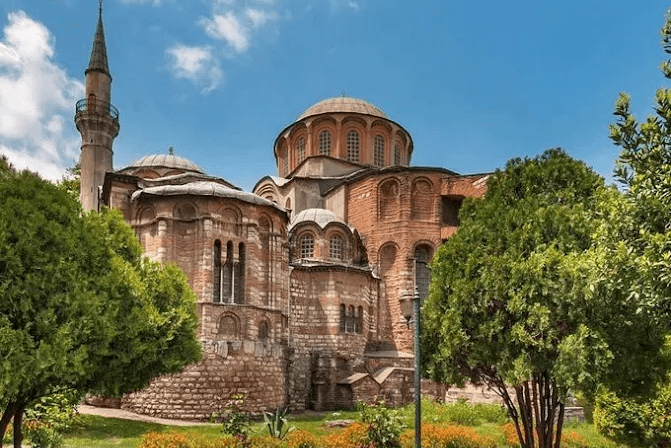
The architecture of the Chora Church (Kariye) is a complex and highly developed example of late Byzantine design, characterized by its irregular yet harmonious arrangement of spaces (status: verified). The building consists of a main naos (the central worship space), two superimposed nartheces (the inner and outer vestibules), and a parekklesion (a side chapel) built along its southern flank (status: verified). The exterior, though modest in brickwork, belies the rich interior (status: verified). The true marvels of Chora are its mosaics and frescoes, which are among the finest surviving examples of Byzantine art from the Palaeologan period (status: verified). The mosaics, predominantly found in the nartheces, illustrate profound theological narratives: cycles depicting the Life of the Virgin Mary, the Infancy of Christ, and the Miracles of Christ (status: verified). They are distinguished by their vivid storytelling, use of perspective, and emotional expressiveness, moving beyond purely symbolic representation to a more humanistic portrayal of divine figures (status: verified). These mosaics served not merely as decoration, but as didactic tools, conveying complex biblical and theological concepts to the faithful (status: interpretation). The frescoes, primarily located in the parekklesion, focus on themes of death, resurrection, and salvation (status: verified). The most famous fresco, the Anastasis (Harrowing of Hell), depicts Christ descending into Hades to rescue Adam and Eve and other figures, a powerful representation of triumph over death (status: verified). The frescoes demonstrate a departure from earlier Byzantine styles, exhibiting a newfound naturalism and dynamism that anticipates aspects of the Italian Renaissance (status: verified). Together, these artworks offer a comprehensive visual program that explores humanity's redemption through Christ, solidifying Chora's importance as a theological and artistic monument (status: verified).
Neighborhood: Zeyrek: Istanbul's Enduring Byzantine and Ottoman Layers
People
Andronikos II PalaiologosByzantine emperor
Andronikos II Palaiologos was a Byzantine emperor who reigned from 1282 to 1328. Born in Nicaea (now İznik, Turkey) in 1259, he was the eldest son of Michael VIII Palaiologos, who had recovered Constantinople in 1261. Andronikos II became sole emperor upon his father's death, ruling from Constantinople (now Istanbul). His reign is widely considered to mark the beginning of the final decline of the Byzantine Empire, characterized by economic difficulties, a weakened military, and the loss of Anatolian territories to the Ottoman Turks. Despite these challenges, he sponsored a revival of Byzantine art and culture and championed the independence of the Eastern Orthodox Church. The later years of his rule were marked by civil war with his grandson, leading to his forced abdication in 1328. His policies and the struggles he faced directly impacted Constantinople's ability to defend itself and maintain its historical prominence.
Theodore MetochitesByzantine statesman, scholar, and patron of the arts
Theodore Metochites (c. 1270 – 1332) was a prominent Byzantine statesman, scholar, philosopher-astronomer, and patron of the arts. He held high political offices, including personal adviser (mesazōn) and Grand Logothete (prime minister) to Emperor Andronikos II Palaiologos from around 1305 to 1328. His significant contribution to Istanbul's history is his extensive patronage and restoration of the Chora Monastery (now Kariye Mosque or Kariye Museum) between approximately 1310 and 1321, overseeing its comprehensive rebuilding and lavish decoration with mosaics and frescoes representative of the "Palaeologian Renaissance." A renowned scholar, he compiled philosophical texts, wrote on astronomy, rhetoric, and poetry, and founded a public library. After the deposition of Andronikos II in 1328, he was exiled but later returned to Constantinople (modern-day Istanbul) and retired as a monk at the Chora Monastery, where he died in 1332.
Mehmed IIOttoman sultan
Mehmed II, also known as Mehmed the Conqueror, was an Ottoman Sultan who reigned from 1444 to 1446 and then again from 1451 until 1481. Born in Edirne in 1432, he is a pivotal figure in Ottoman and world history. At the age of 21, he conquered Constantinople, the capital of the Byzantine Empire, on May 29, 1453. This event marked the end of the Byzantine Empire and is seen as a transition from the Middle Ages to the Renaissance. Following the conquest, he transformed Constantinople into Istanbul, the new capital of the Ottoman Empire, and initiated extensive rebuilding and development projects. These included the construction of the Fatih Mosque complex and the Topkapi Palace, and the conversion of the Hagia Sophia into a mosque. He also had the Rumeli Fortress built to aid in the siege. Mehmed II encouraged the repopulation of Istanbul by inviting diverse communities, fostering its restoration as a grand political, economic, and social center.
Frequently asked questions
What does 'Chora' mean and why is the church named that?
The name 'Chora' (Greek: ἡ Ἐκκλησία τοῦ Ἁγίου Σωτῆρος ἐν τῇ Χώρᾳ) translates to 'in the country' or 'outside the city' (status: verified). This designation reflects its original location beyond the 4th-century Constantinian walls of Constantinople, before the later Theodosian Walls were constructed (status: verified).
Who was Theodore Metochites and what was his role at Chora?
Theodore Metochites was a prominent Byzantine statesman, scholar, and patron of the arts in the early 14th century, serving as the chief minister to Emperor Andronikos II Palaeologos (status: verified). He was the primary patron responsible for the extensive rebuilding and extraordinary artistic decoration of the Chora Church between 1315 and 1321, transforming it into the masterpiece seen today (status: verified).
What is the significance of the Chora's mosaics and frescoes?
The mosaics and frescoes of Chora are considered a zenith of the Palaeologan Renaissance in Byzantine art (status: verified). They are significant for their vivid narrative cycles, emotional depth, classical influences, and sophisticated artistic techniques that demonstrate a departure from earlier, more rigid styles (status: verified). The artworks served as theological narratives, guiding the faithful through the lives of Christ and the Virgin, and illustrating themes of salvation and resurrection (status: verified).
What is the 'Anastasis' fresco and why is it important?
The 'Anastasis' (Harrowing of Hell) is the most famous fresco within the parekklesion (side chapel) of Chora (status: verified). It depicts Christ, having broken the gates of Hell, pulling Adam and Eve from their tombs, symbolizing the resurrection of humanity and the triumph over death (status: verified). It is celebrated for its dramatic composition and powerful theological message (status: verified).
How did Chora transform after the Ottoman conquest?
Following the Ottoman conquest of Constantinople in 1453, the Chora Church was converted into a mosque, known as Kariye Camii (status: verified). During this conversion, its mosaics and frescoes were covered with plaster, as per Islamic custom regarding figural representations in places of worship (status: verified).
What is the current status of the Chora Church (Kariye)?
The Chora Church, after serving as a museum (Kariye Müzesi) from 1945, was officially reconverted into a mosque (Kariye Camii) by a presidential decree in 2020 (status: verified). This change in status has involved the process of preparing the site for Islamic worship (status: verified).
What makes the Chora's art unique within Byzantine tradition?
The art at Chora is unique for its synthesis of traditional Byzantine iconography with a new emphasis on naturalism, emotion, and narrative detail, characteristic of the Palaeologan Renaissance (status: verified). Unlike earlier, more static forms, the Chora's artists explored human psychology and dramatic storytelling, making the divine narratives exceptionally vivid and relatable (status: verified).
Is the Chora Church accessible to visitors?
As a functioning mosque, the Chora Church (Kariye Camii) is open for visitors outside of prayer times, allowing for observation of its architectural and artistic heritage (status: verified). Access and viewing might be subject to the customs and regulations of a religious worship site (status: needs_verification).
Written by Istanbook Editorial Team
Sources (1)
- artandobject.com — artandobject.com