Places
The Land Walls of Constantinople
Overview
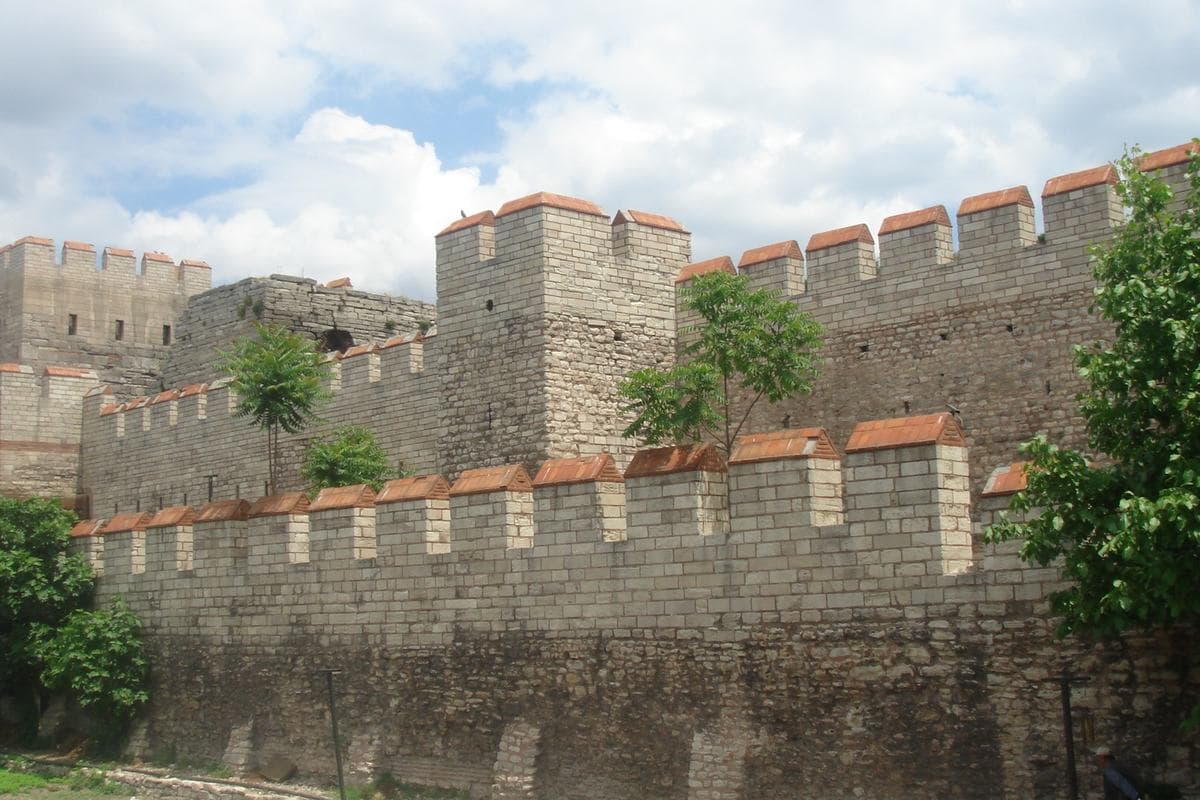
The Land Walls of Constantinople stand as a monumental testament to Byzantine ingenuity and a potent symbol of one of history's most enduring empires. For over a millennium, these formidable fortifications protected the city from countless invaders, shaping its destiny and earning it the moniker 'Queen of Cities'. More than mere barriers, the walls represented the physical embodiment of Constantinople's strategic importance, a sophisticated defensive system that integrated architecture with the natural landscape. Even today, their weathered stones trace the contours of the old city, whispering tales of resilience, imperial power, and ultimate conquest.
History
The earliest fortifications of Constantinople were erected by Emperor Constantine the Great in the 4th century, enclosing a much smaller area verified (UNESCO World Heritage Centre — Historic Areas of Istanbul). However, as the city expanded, a more extensive defense system became necessary. The famed Theodosian Walls were constructed in the early 5th century under the reign of Emperor Theodosius II, largely orchestrated by the Praetorian Prefect Anthemius verified (UNESCO World Heritage Centre — Historic Areas of Istanbul). This new line of defense stretched approximately 6.5 kilometers (4 miles) from the Golden Horn to the Sea of Marmara, effectively tripling the size of the walled city verified (UNESCO World Heritage Centre — Historic Areas of Istanbul). Frequent earthquakes and the relentless pressure of various sieges necessitated continuous repairs and modifications throughout the Byzantine era verified (Bilkent University Repository). For centuries, the Land Walls proved their impregnability against formidable adversaries, including the Avars and Arabs in the 7th and 8th centuries, and later the Bulgars and Rus' verified (Istanbul University research). These defenses were repeatedly tested and consistently held, establishing Constantinople's reputation as an unassailable stronghold verified (Istanbul University research). The walls played their most dramatic role during the Ottoman conquest of 1453, when Sultan Mehmed II deployed powerful cannons against them, particularly near the Gate of St. Romanus (Topkapı) verified (UNESCO World Heritage Centre — Historic Areas of Istanbul). Despite the walls' unprecedented strength, the prolonged bombardment and a final, overwhelming assault ultimately led to the city's fall verified (UNESCO World Heritage Centre — Historic Areas of Istanbul). Following the conquest, the walls gradually transformed from active military defenses into an integral part of the expanding urban fabric of Ottoman Istanbul verified (Fatih Municipality). While some sections were maintained, others fell into disrepair or were incorporated into new residential areas and gardens verified (Fatih District Governorate). The land immediately outside the walls, once a barren no-man's-land, began to see settlement, especially in areas like Eyüp: Istanbul's Sacred Sanctuary on the Golden Horn.
Architecture
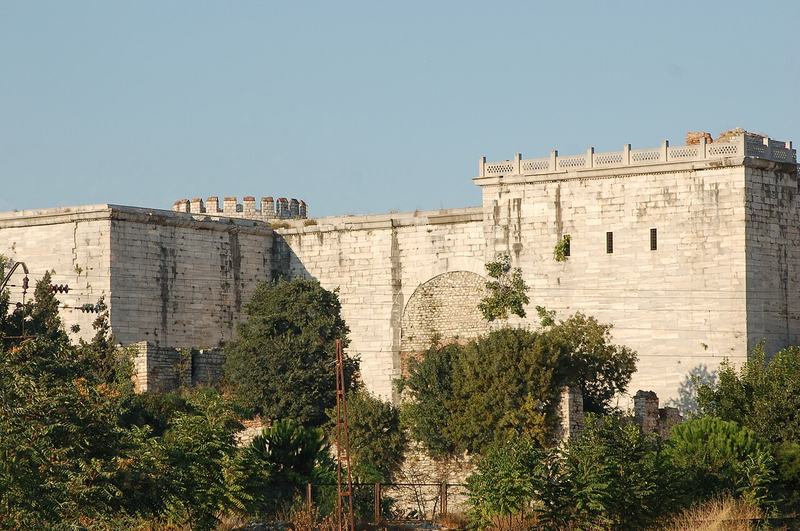
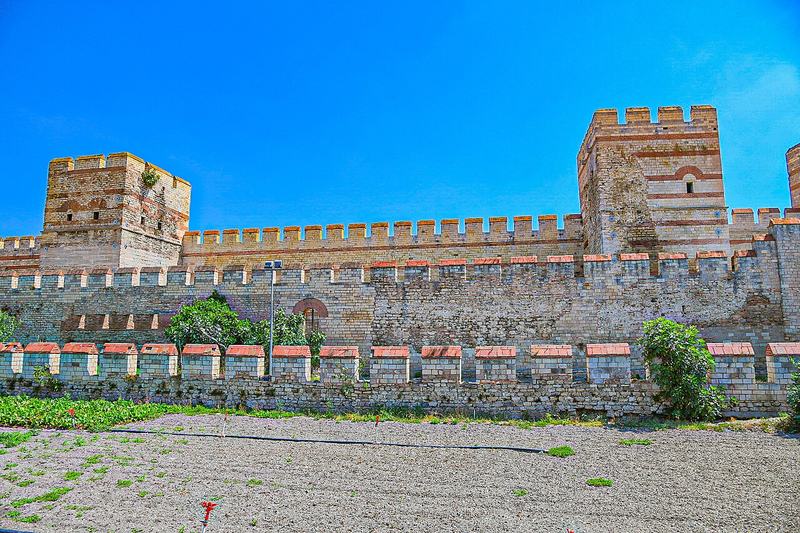
The Land Walls of Constantinople represent one of the most sophisticated and effective defensive systems of the medieval world, consisting of a triple line of defense verified (UNESCO World Heritage Centre — Historic Areas of Istanbul). The outermost element was a wide ditch, or *moat*, approximately 20 meters (65 feet) wide and 10 meters (33 feet) deep, which could be flooded verified (Bilkent University Repository). Behind the moat lay the *Exoteichisma* or 'Outer Wall,' a relatively low wall, 2 meters (6.5 feet) thick and 5 meters (16 feet) high, punctuated by small towers. This wall also served as a *peribolos*, an open space for military maneuvers. The second line was the *Proteichisma* or 'Outer Terrace Wall,' about 8 meters (26 feet) high and supported by numerous square towers, each separated by around 50 meters (164 feet) verified (UNESCO World Heritage Centre — Historic Areas of Istanbul). This wall created an inner terrace or *peribolos* where troops could regroup. The most imposing feature was the *Mega Teichos* or 'Inner Wall,' a colossal structure approximately 5 meters (16 feet) thick and 12 meters (39 feet) high, adorned with 96 towers that reached heights of up to 20 meters (65 feet) verified (UNESCO World Heritage Centre — Historic Areas of Istanbul). These towers, typically square or octagonal, were strategically placed to allow for interlocking fields of fire. The walls were constructed of alternating courses of brick and limestone, a technique that provided both structural resilience against earthquakes and aesthetic appeal verified (Bilkent University Repository). Numerous gates punctuated the walls, some for civilian traffic like the Charisius Gate (Edirne Kapı) and others for ceremonial entry, most famously the Golden Gate, adorned with marble and a triumphal arch, intended for imperial processions verified (UNESCO World Heritage Centre — Historic Areas of Istanbul). The surrounding landscape, including the undulating terrain, was cleverly integrated into the defensive strategy, maximizing the walls' effectiveness verified (Istanbul University research).
Neighborhood: Arnavutköy: A Bosphorus Neighborhood's Greek Legacy
People
Theodosius IIEastern Roman Emperor
Theodosius II was the Eastern Roman Emperor from 408 to 450 CE, born in Constantinople (modern-day Istanbul) in 401. He became sole ruler at a young age, with his early reign guided by regents including the praetorian prefect Anthemius and his elder sister Pulcheria. His rule is significant for Istanbul's history due to several major initiatives: the construction of the formidable Theodosian Walls, which protected the city for centuries; the founding of the University of Constantinople in 425 CE, an early institution of higher learning; and the compilation of the Codex Theodosianus, an influential legal code. Theodosius II was characterized as a gentle and scholarly individual, often allowing relatives and ministers to manage much of the empire's governance.
Mehmed IIOttoman sultan
Mehmed II, also known as Mehmed the Conqueror, was an Ottoman Sultan who reigned from 1444 to 1446 and then again from 1451 until 1481. Born in Edirne in 1432, he is a pivotal figure in Ottoman and world history. At the age of 21, he conquered Constantinople, the capital of the Byzantine Empire, on May 29, 1453. This event marked the end of the Byzantine Empire and is seen as a transition from the Middle Ages to the Renaissance. Following the conquest, he transformed Constantinople into Istanbul, the new capital of the Ottoman Empire, and initiated extensive rebuilding and development projects. These included the construction of the Fatih Mosque complex and the Topkapi Palace, and the conversion of the Hagia Sophia into a mosque. He also had the Rumeli Fortress built to aid in the siege. Mehmed II encouraged the repopulation of Istanbul by inviting diverse communities, fostering its restoration as a grand political, economic, and social center.
Frequently asked questions
What are the Land Walls of Constantinople?
The Land Walls of Constantinople are a series of defensive stone walls that protected the Byzantine capital, Constantinople (modern-day Istanbul), for over a thousand years. They were a crucial element of the city's defenses, stretching across the peninsula from the Golden Horn to the Sea of Marmara verified (UNESCO World Heritage Centre — Historic Areas of Istanbul).
When were the most significant sections of the walls built?
The most significant and extensive sections of the Land Walls, known as the Theodosian Walls, were built in the early 5th century AD under the reign of Emperor Theodosius II verified (UNESCO World Heritage Centre — Historic Areas of Istanbul).
How did the Land Walls function as a defensive system?
The Land Walls featured a sophisticated triple line of defense: an outer moat, a lower outer wall (Proteichisma) with towers, and a massive inner wall (Mega Teichos) with taller, more numerous towers. This layered design provided multiple barriers against attackers and allowed defenders to engage enemies at different ranges verified (Bilkent University Repository).
What role did the walls play in the Ottoman conquest of 1453?
The Land Walls were the site of the final, decisive battle during the Ottoman conquest of 1453. Despite their legendary strength, they were ultimately breached by the powerful cannons and persistent assaults of Sultan Mehmed II's army, leading to the fall of Constantinople verified (UNESCO World Heritage Centre — Historic Areas of Istanbul).
Are parts of the Land Walls still visible today?
Yes, significant sections of the Land Walls are still visible today, running through various districts of Istanbul's historical peninsula. Many gates, such as the Golden Gate and the Charisius Gate (Edirne Kapı), also survive, though often in modified forms verified (Fatih District Governorate).
How are the Land Walls preserved in modern Istanbul?
The Land Walls are recognized as a UNESCO World Heritage site as part of the 'Historic Areas of Istanbul' verified (UNESCO World Heritage Centre — Historic Areas of Istanbul). Preservation efforts include restoration projects, although challenges remain due to urban development and the sheer scale of the ancient structure verified (Fatih Municipality).
What is the significance of the Golden Gate?
The Golden Gate was a highly ceremonial entrance to Constantinople, adorned with marble and triumphal arches. It was primarily used for imperial processions and triumphs, symbolizing the city's power and grandeur verified (UNESCO World Heritage Centre — Historic Areas of Istanbul).
Were the walls ever breached before 1453?
While the walls withstood numerous sieges, including those by the Avars, Arabs, and Bulgars, they were ultimately breached by the Fourth Crusade in 1204, though this was primarily an assault from the sea walls and through gates that were poorly defended, rather than a direct breach of the main land defenses.
How did the city adapt the walls after the Ottoman conquest?
After the Ottoman conquest, the walls gradually lost their primary defensive function. While some sections were maintained, others were integrated into new urban structures, serving as boundaries for neighborhoods or being partially built over as the city expanded beyond its ancient limits verified (Fatih Municipality).
Written by Istanbook Editorial Team
Sources (2)
- ancientworldmagazine.com — ancientworldmagazine.com
- aa.com.tr — aa.com.tr