Places
The Theodosian Walls of Constantinople
Overview
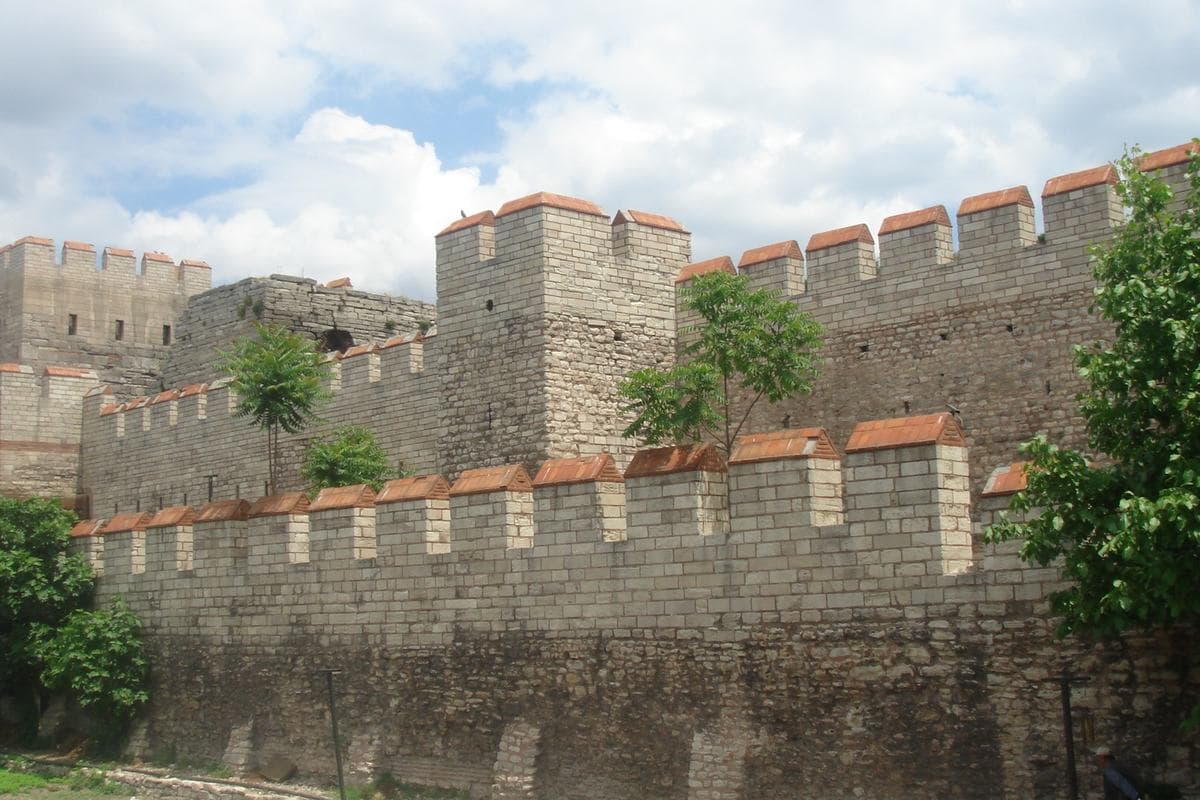
The Theodosian Walls, the formidable land defenses of ancient Constantinople, stand as a testament to Byzantine engineering and the city's enduring resilience. These monumental fortifications, stretching approximately 6.5 kilometers (4 miles) across the European peninsula, shielded the city from numerous invaders for over a millennium. Far more than mere barriers, they represent a layered defensive system that allowed Constantinople, the capital of the Byzantine Empire, to thrive as a center of culture, trade, and power. Walking along their preserved sections today offers a profound sense of the city's historical scale and its strategic importance.
History
The construction of the original land walls of Constantinople began under Emperor Theodosius II in the early 5th century CE. The first iteration, known as the Theodosian Wall (sometimes referred to as the 'Antonian Wall' by some scholars, though the Theodosian name is more common for the larger system), was built between 408 and 413 CE under the supervision of the Praetorian Prefect Anthemius. This initial wall was prompted by the rapid expansion of the city beyond the older Constantinian Walls and the growing threat of barbarian incursions, particularly from the Huns. A devastating earthquake in 447 CE caused significant damage, leading to an urgent reconstruction and enhancement project. Under the direction of Prefect Constantine, a second, outer wall was added, creating the iconic triple-layered defense system that would characterize the Theodosian Walls for centuries. This swift rebuilding, reportedly completed in just two months with the labor of the city's factions, was crucial for repelling Attila the Hun's advance on the city. Throughout the Byzantine era, the walls faced and largely withstood numerous sieges from various adversaries, including the Avars, Arabs, Bulgars, and Rus'. Their sophisticated design and the determination of the defenders allowed Constantinople to remain unconquered until 1204, when the Fourth Crusade breached the sea walls, not the land walls, to capture the city. The final and most famous siege occurred in 1453 when Sultan Mehmed II's Ottoman forces laid siege to Constantinople. Despite the walls' formidable nature, prolonged artillery bombardment, including the use of massive cannons, and a coordinated assault eventually led to their breach and the fall of the city on May 29, 1453. The capture marked the end of the Byzantine Empire and the beginning of the Ottoman era in Istanbul. In the centuries that followed, sections of the walls fell into disrepair or were repurposed. Urban expansion in the modern era led to some sections being demolished or integrated into new structures. However, significant restoration efforts, particularly in the 20th and 21st centuries, have aimed to preserve and reconstruct large parts of this historical monument.
Architecture
The Theodosian Walls represent one of the most advanced and complex defensive systems of the medieval world, designed to repel both infantry and siege engines. The primary defense consisted of three parallel layers: 1. **The Moat (Fossa):** Approximately 20 meters (65 feet) wide and 10 meters (33 feet) deep, this dry moat was the outermost barrier, designed to slow down attackers and make siege ladders ineffective. A low crenellated wall, known as the 'Parateichion' or 'Proteichisma', bordered the inner edge of the moat. 2. **The Outer Wall (Exoteichisma):** Standing about 8.5 meters (28 feet) tall, this wall was equipped with regularly spaced rectangular towers, typically 5 to 9 meters (16 to 30 feet) high. It provided an initial line of defense and a firing platform for archers. 3. **The Inner Wall (Mega Teichos):** This was the main defensive structure, a massive barrier reaching up to 12 meters (40 feet) in height and 5 meters (16 feet) thick. It featured 96 impressive towers, mostly square or octagonal, rising 18 to 20 meters (60 to 65 feet) above the ground. These towers were strategically placed, typically 50 to 55 meters (165 to 180 feet) apart, allowing for interlocking fields of fire. A wide terrace, the 'Peribolos', separated the Inner and Outer Walls, providing space for troop movements and counter-attacks. The walls were constructed with alternating courses of dressed limestone blocks and bricks, filled with mortar and rubble, making them highly resistant to earthquakes and impacts. Major gates, such as the Golden Gate (Porta Aurea), the Gate of Xylokerkos, and the Gate of St. Romanus, were heavily fortified, often flanked by massive towers and equipped with portcullises. The Golden Gate, in particular, served as a triumphal arch, reserved for imperial entrances.
Neighborhood: Zeyrek: Istanbul's Enduring Byzantine and Ottoman Layers
People
Theodosius IIEastern Roman Emperor
Theodosius II was the Eastern Roman Emperor from 408 to 450 CE, born in Constantinople (modern-day Istanbul) in 401. He became sole ruler at a young age, with his early reign guided by regents including the praetorian prefect Anthemius and his elder sister Pulcheria. His rule is significant for Istanbul's history due to several major initiatives: the construction of the formidable Theodosian Walls, which protected the city for centuries; the founding of the University of Constantinople in 425 CE, an early institution of higher learning; and the compilation of the Codex Theodosianus, an influential legal code. Theodosius II was characterized as a gentle and scholarly individual, often allowing relatives and ministers to manage much of the empire's governance.
Mehmed IIOttoman sultan
Mehmed II, also known as Mehmed the Conqueror, was an Ottoman Sultan who reigned from 1444 to 1446 and then again from 1451 until 1481. Born in Edirne in 1432, he is a pivotal figure in Ottoman and world history. At the age of 21, he conquered Constantinople, the capital of the Byzantine Empire, on May 29, 1453. This event marked the end of the Byzantine Empire and is seen as a transition from the Middle Ages to the Renaissance. Following the conquest, he transformed Constantinople into Istanbul, the new capital of the Ottoman Empire, and initiated extensive rebuilding and development projects. These included the construction of the Fatih Mosque complex and the Topkapi Palace, and the conversion of the Hagia Sophia into a mosque. He also had the Rumeli Fortress built to aid in the siege. Mehmed II encouraged the repopulation of Istanbul by inviting diverse communities, fostering its restoration as a grand political, economic, and social center.
Frequently asked questions
When were the Theodosian Walls built?
The initial construction of the main Theodosian Wall occurred between 408 and 413 CE. The outer wall and moat system, completing the iconic triple-layered defense, were added after a devastating earthquake in 447 CE.
How long are the Theodosian Walls?
The land walls of Constantinople stretch for approximately 6.5 kilometers (4 miles) across the European peninsula, from the Sea of Marmara to the Golden Horn.
What made the Theodosian Walls so strong?
Their strength lay in their sophisticated, multi-layered design: a deep moat, a lower outer wall with towers, and a massive inner wall with even taller, more numerous towers. This system allowed for overlapping fields of fire and made direct assault extremely difficult.
Which Ottoman Sultan finally conquered Constantinople by breaching the walls?
Sultan Mehmed II led the Ottoman forces that finally breached the Theodosian Walls and captured Constantinople in 1453, ending the Byzantine Empire.
Can I walk along the Theodosian Walls today?
Yes, many sections of the Theodosian Walls are still standing and accessible for walking. Exploring them offers a unique perspective on the historical scale of the city.
What is the significance of the Golden Gate?
The Golden Gate (Porta Aurea) was one of the most magnificent gates in the Theodosian Walls, serving as a triumphal arch for emperors entering the city after military victories.
Which neighborhoods are near the Theodosian Walls?
The Theodosian Walls stretch through or near several historic neighborhoods, including Fener: Istanbul's Historic Greek Quarter, Balat: A Tapestry of Cultures on the Golden Horn, and Eyüp: Istanbul's Sacred Sanctuary on the Golden Horn.
Written by Istanbook Editorial Team