The Horses Constantinople Lost
AI-assisted historical reconstruction

君士坦丁堡失落的骏马

四尊古代雕塑如何从拜占庭竞技场,辗转跨越至威尼斯,承载着数个世纪的帝国记忆。

1 min read

The Horses Constantinople Lost
在圣马可广场之上,俯瞰着威尼斯流淌不息的日常景致,四匹镀金骏马昂首伫立,永远定格在一个昂扬奋进的瞬间。这些庄严的雕塑,早已深深融入这座「宁静共和国」的身份象征之中,也让每一位好奇的旅人心生同一个疑问:这些古老的骏马,为何会出现在威尼斯?

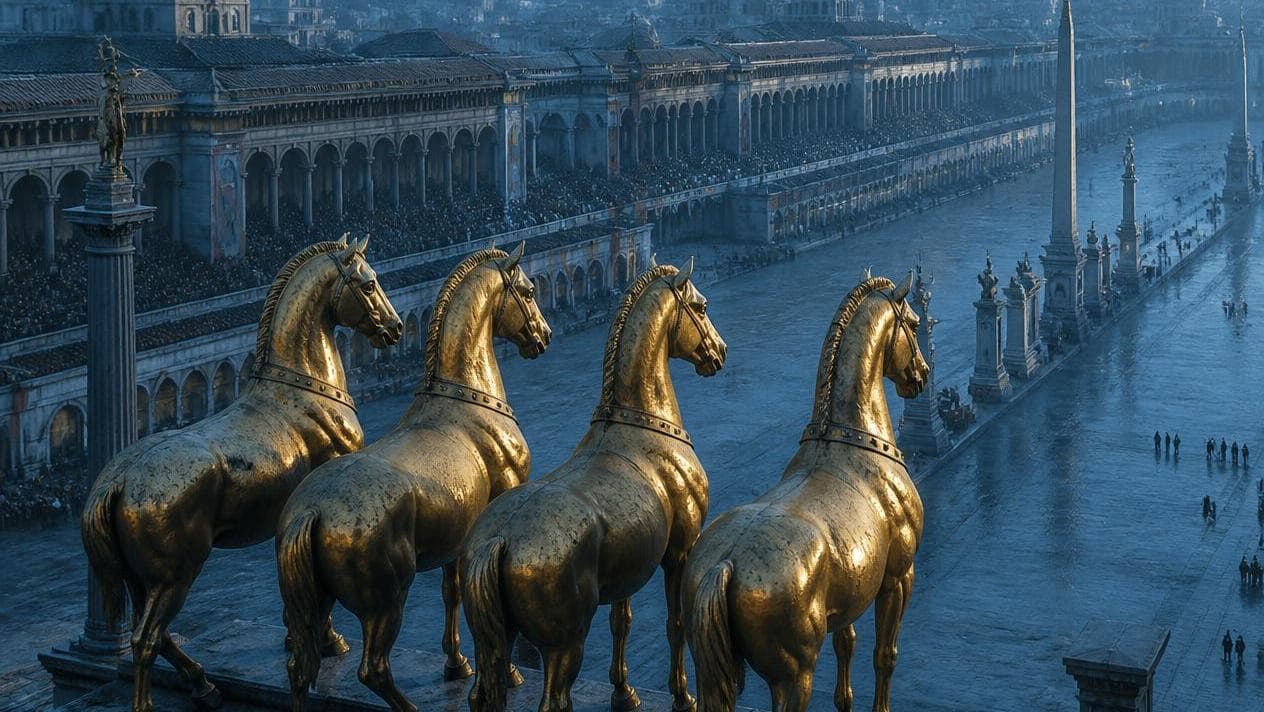
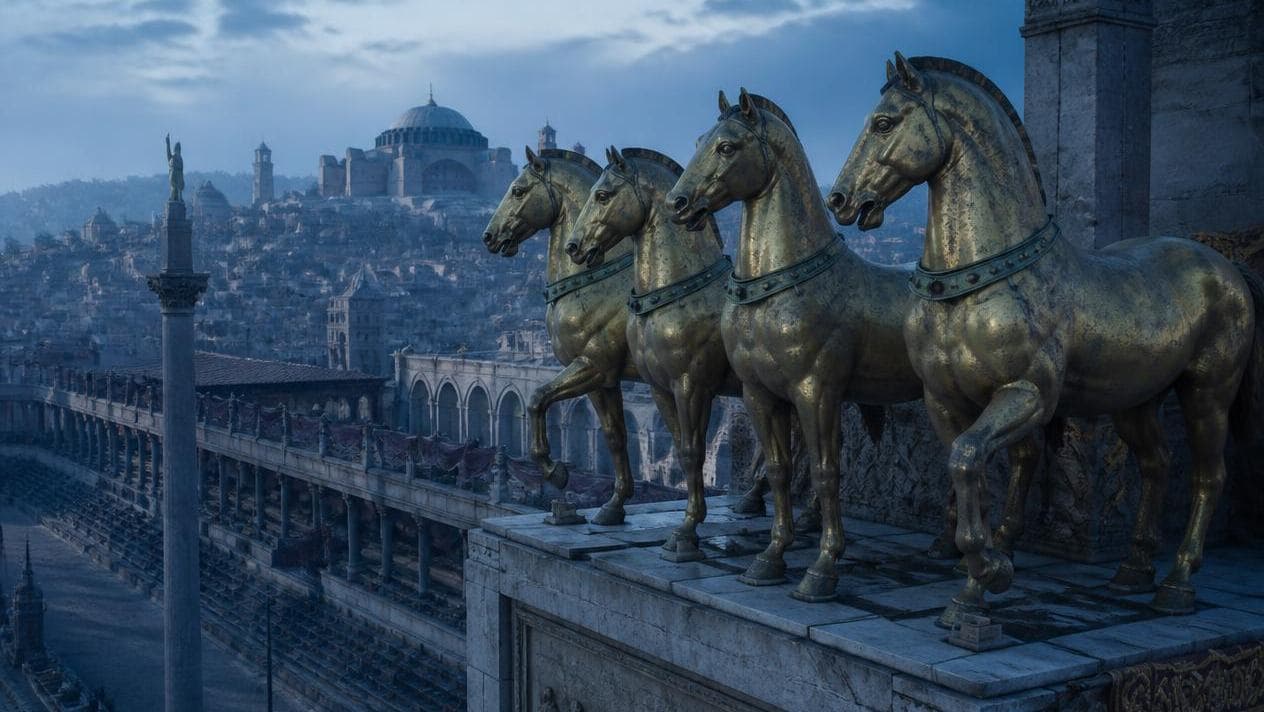
早在它们装点圣马可大教堂立面之前很久,这些骏马便是拜占庭帝国宏伟都城——君士坦丁堡竞技场的重要陈设。这座宏大的竞技场,最初由罗马皇帝塞普蒂米乌斯·塞维鲁于约公元203年始建,后在公元330年君士坦丁一世重建这座城市时大幅扩建,它远不止是一座简单的战车竞赛场馆。在长达千余年的岁月中,它一直是君士坦丁堡政治、礼仪与社会生活的跳动心脏。历代皇帝可从大皇宫直接进入竞技场,将其作为展示帝国权威、通过盛大庆典、阅兵游行与公开演说与民众互动的舞台。竞技场内陈列着从帝国各地运来的宏伟雕塑,包括方尖碑与石柱,是拜占庭帝国实力与深远影响力的有力视觉宣言。由四匹马拉动的战车雕塑「四马战车」,通常陈列在起跑门(被称为carceres,即「狄皮翁」)之上的高处,使其成为一道引人注目、熠熠生辉的景观。

圣马可四骏马确切的起源与年代,至今仍是学界争论不休的话题。尽管它们无疑是古典时代的作品,但其确切的制作地点尚无定论。一些学者认为它们制作于希腊化时期,或早至公元前4世纪,较早的归属说法有时将其指向希腊雕塑家利西波斯,但这一说法并未成为定论。另有理论提出罗马起源说,将其年代定为公元2或3世纪,可能是为塞普蒂米乌斯·塞维鲁皇帝所制。分析显示,这些雕塑几乎由纯铜铸成,铜含量约达96%,仅含少量的铅与锡,而非典型的青铜合金。这种不寻常的成分构成,表明它们是刻意以此方式铸造,以便于镀金处理——这使得它们在最初展示之时能够熠熠生辉。它们修长的腿部与略显短促的背部,进一步表明其设计初衷是供人从下方仰视,很可能曾用于装饰某座凯旋门或纪念性建筑的顶部。一部8世纪的拜占庭编年史《城市简史》(Parastaseis syntomoi chronikai)中提及「矗立于竞技场之上的四匹镀金骏马」或类似的群像,进一步证实了它们在1204年之前便与君士坦丁堡有着悠久的渊源。还有一种说法认为,它们可能是在狄奥多西二世皇帝在位期间(公元408–450年)从希俄斯岛运至君士坦丁堡的。

第四次十字军东征期间,这些骏马的命运迎来了戏剧性的转折。原本是一场前往圣地的朝圣之旅,却因对威尼斯所欠下的财务义务而被迫改道,最终酿成了令人难以想象的后果:这座基督教城市君士坦丁堡遭到围攻并被洗劫一空。1204年4月13日,由年迈的总督恩里科·丹多洛率领的威尼斯军队攻破了这座城市的防线。随后而来的,是长达三天惨烈的浩劫,这座拜占庭帝国的都城遭受了大规模的劫掠、破坏与亵渎。珍贵的艺术品、宗教圣物与巨额财宝被洗劫一空,这也成为历史上规模最大的艺术品转移事件之一。1204年的这场浩劫,对君士坦丁堡造成了无可挽回的损害,使拜占庭帝国从此一蹶不振,并将其推向最终覆灭的道路。

在这场征服的战利品之中,便包括这四匹青铜骏马。威尼斯人拆解了整座四马战车,为便于跨越亚得里亚海运输,甚至将马首一一斩下。抵达威尼斯后,这些骏马最初被存放在这座城市的造船厂——阿森纳莱,长达约五十年之久。约公元1254年,它们被安置于圣马可大教堂中央拱门上方的回廊之上,这一经过深思熟虑的决定,彻底改变了它们的象征意义。它们不再是君士坦丁堡的帝国纪念物,而是化身为威尼斯权力、海上霸权与共和国荣耀的有力象征。骏马颈部新添的项圈,巧妙地掩盖了当初为拆卸与运输而留下的切割痕迹。

数个世纪之后,这些骏马再度被历史的浪潮所裹挟,命运再次改变。1797年,随着威尼斯共和国在拿破仑·波拿巴的军队面前覆灭,这四匹骏马被强行从圣马可大教堂移走。它们被运往巴黎,拿破仑试图将其纳入自己的帝国象征体系,用以装饰卡鲁塞尔凯旋门。这一举动,恰如当年威尼斯对拜占庭象征的挪用,拿破仑意图借此将自己与罗马昔日凯旋荣光的伟业相提并论。然而,它们在巴黎的停留只是暂时的。1815年拿破仑最终战败后,这些骏马被归还威尼斯,重新安放于圣马可大教堂的立面之上,这是一次意义重大的文化回归。

此后数个世纪间,这些骏马始终暴露于圣马可广场上空的风雨之中。然而,岁月的侵蚀与日益严重的空气污染,最终对这些古老的雕塑造成了损害。为保护这些无价的文物免受进一步的侵蚀,原版骏马于1980年代初——具体为约1982年或1983年——被小心地从大教堂立面移下。取而代之的,是与原作分毫不差的复制品,如今游客在大教堂外部所见的,正是这些复制品。原版古老骏马如今被珍藏于室内,陈列在圣马可大教堂内部的圣马可博物馆中,供游客近距离欣赏其非凡的工艺。

What remains today

如今,昔日宏伟的君士坦丁堡竞技场,作为伊斯坦布尔的苏丹艾哈迈德广场(又称「阿特梅丹」,意为「马匹广场」)而延续着自己的生命。尽管古老的跑道与庞大的看台早已不复存在,这片开阔的空间在很大程度上仍保留着这座历史竞技场原有的轮廓。前来苏丹艾哈迈德广场的游客,依然能看到数座曾装点竞技场中脊(spina)的重要纪念物。其中包括从埃及运来的巍峨的狄奥多西方尖碑、原本来自德尔斐的蛇柱,以及砖石砌成的墙式方尖碑。这些留存至今的建筑,是竞技场昔日荣光及其在拜占庭公共生活中核心地位的有力见证。然而,这四匹青铜骏马从这处历史遗址上的消失,也令人心生感慨——它见证着这座城市历经数个世纪变迁、征服与重建所失去的众多珍宝,以及其复杂厚重的过往。

「君士坦丁堡失落的骏马」这一故事,是一段跨越千年、串联起不同地域与人物的叙事长卷。它诉说着权力潮起潮落的变迁,艺术作为战利品与象征的流转,以及人类对精湛工艺历久弥新的痴迷。要真正理解这段历史,游客不妨先站在伊斯坦布尔的苏丹艾哈迈德广场,任由想象力填满这片曾经竞技场喧嚣鼎沸的辽阔空间,追忆骏马曾经伫立之处。而后,一趟前往威尼斯圣马可大教堂与圣马可博物馆的旅程,则提供了一个难得的机会,让人得以近距离邂逅这些同样古老的雕塑,亲眼见证这份君士坦丁堡失落遗产的实物见证——如今在另一座同样举世闻名的城市中,得到珍藏与礼赞。

People

Enrico DandoloDoge of Venice, leader during the Fourth Crusade

Enrico Dandolo was a prominent Venetian statesman who served as the Doge of Venice from 1192 until his death in 1205. Born around 1107, he came from an influential family and became Doge in his late 80s, despite being largely blind. His significance for Istanbul, then known as Constantinople, primarily stems from his decisive leadership during the Fourth Crusade (1202-1204). Dandolo played a key role in diverting the Crusade, initially intended for the Holy Land, first to Zara and then to Constantinople, influencing the Crusaders to attack the city to settle their debt and further Venetian interests. Under his command, the Venetian fleet participated in the siege and subsequent Sack of Constantinople in 1204, an event that led to the overthrow of the Byzantine Empire and the establishment of the Latin Empire. Venice gained substantial territories and trade advantages from this conquest, and Dandolo himself took the title "lord of the fourth part and a half of the whole empire of Romania." He died in Constantinople in 1205 and was buried in the Hagia Sophia. Accounts suggest his tomb was desecrated by the Byzantines upon retaking the city in 1261, with some traditions claiming his remains were scattered or that the tomb was destroyed after the Ottoman conquest in 1453. A plaque bearing his name, "Henricus Dandolo," remains in the Hagia Sophia, though some recent studies suggest it may be a later addition from the 19th century.

Cultures

Romans

The Roman presence in the city now known as Istanbul is fundamental to its identity, beginning with the ancient Greek colony of Byzantium becoming allied with and then part of the Roman Empire. Its significance dramatically escalated when Emperor Constantine I refounded it as Constantinople, or "New Rome," in the 4th century CE. This city then served as the capital of the Eastern Roman Empire, later known as the Byzantine Empire, for over a thousand years, preserving Roman and Hellenistic traditions and shaping much of the city's early urban fabric and cultural significance.

Byzantine Greeks

The term "Byzantine Greeks" refers to the inhabitants of the Byzantine Empire, also known as the Eastern Roman Empire. These individuals considered themselves "Romans" and their culture integrated the legal and administrative traditions of the Roman Empire with the Greek language and other Greek cultural elements. The empire was largely Greek-speaking and served as the spiritual center of the Orthodox religion. The Byzantine Greeks are profoundly important to Istanbul, as the city, then known as Constantinople, served as their capital for over a thousand years.

Venetians in Constantinople

The Venetians established a significant and enduring presence in Constantinople, where they played a crucial role in the city's economic, political, and cultural landscape for centuries. Their community, initially centered in a dedicated quarter near the Golden Horn, maintained strong trading connections and diplomatic influence from the Byzantine era through the Ottoman period, contributing to complex interactions and cultural exchange.

The City Is Made of Neighborhoods

Stories of Istanbul

The exact origin and date of the four bronze horses remain a subject of ongoing scholarly discussion and debate. While their association with Constantinople's Hippodrome before 1204 is well-established, whether they were originally Greek or Roman, or crafted in the Hellenistic period or a later Roman era, is not definitively settled.

Written by Istanbook Editorial Team · Last updated 2026年9月14日

Sources (7)

A story from Istanbul, occasionally.

One story, one place, one taste, one recommendation.