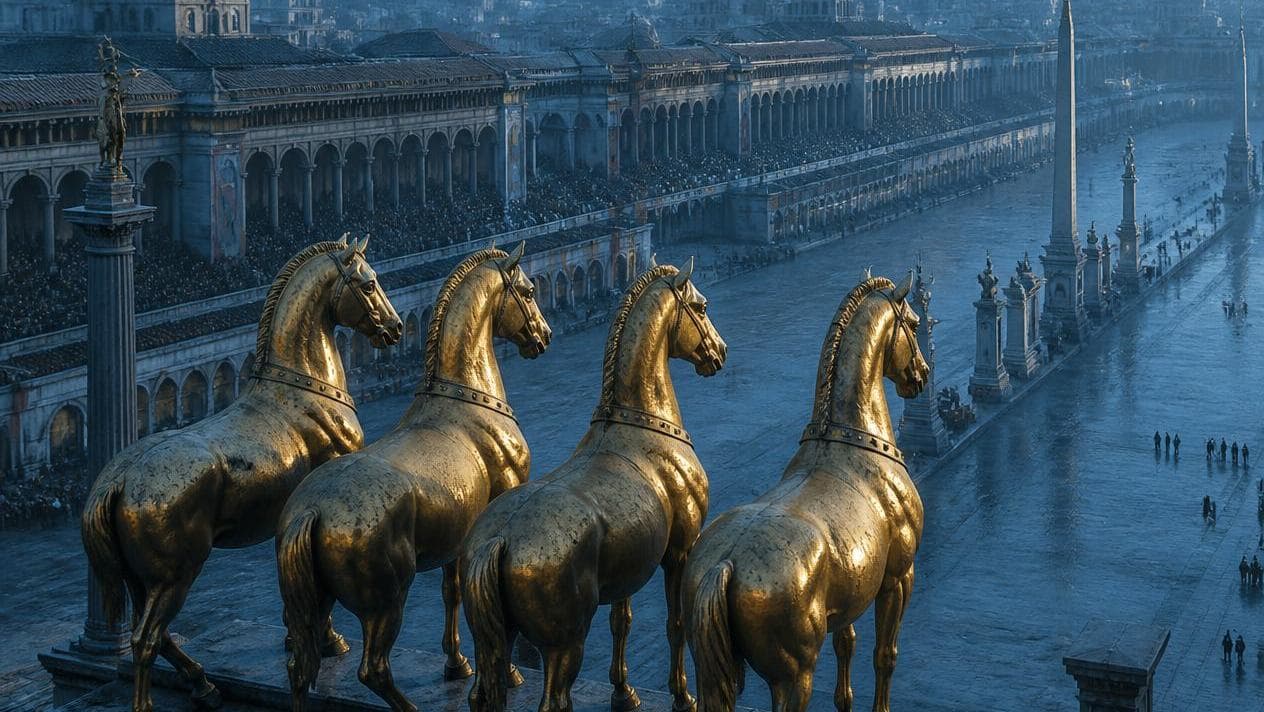
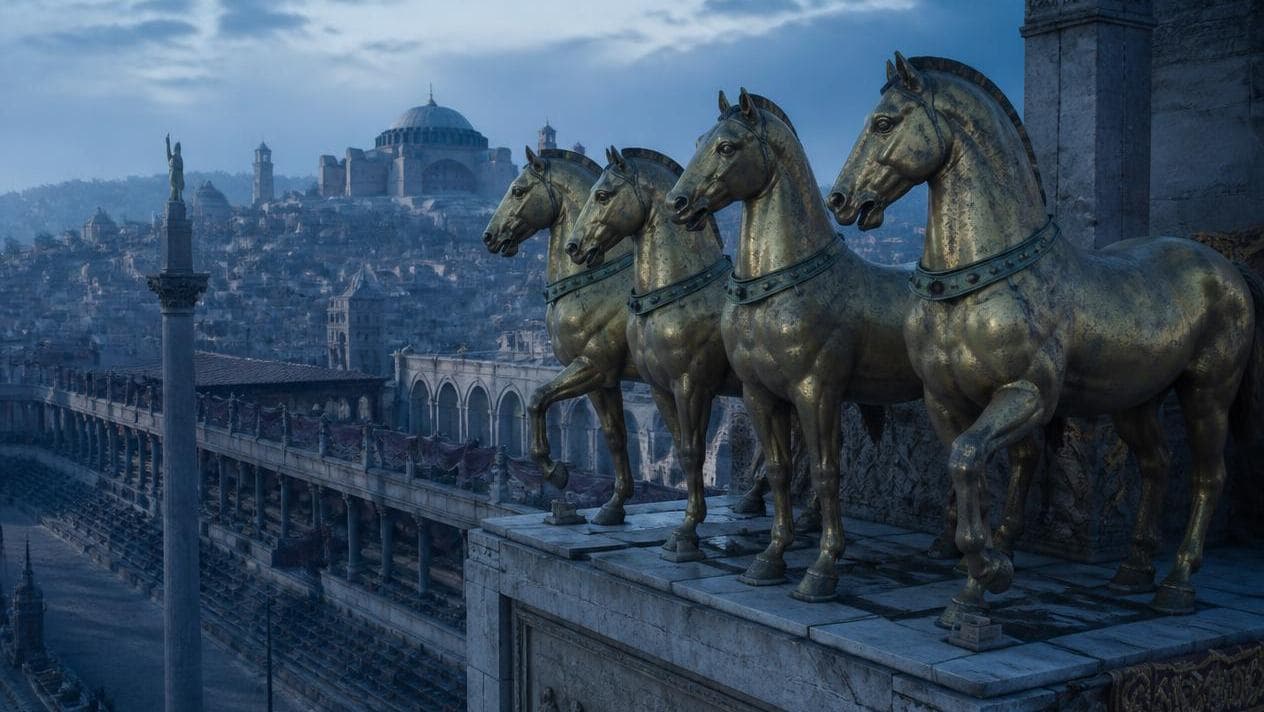
Long before they graced the façade of St. Mark’s Basilica, these horses were a prominent feature of the Hippodrome of Constantinople, the magnificent capital of the Byzantine Empire. This vast arena, initially begun by Roman Emperor Septimius Severus around 203 CE and dramatically enlarged by Constantine I when he refounded the city in 330 CE, was far more than a simple venue for chariot races. It served as the beating heart of Constantinople’s political, ceremonial, and social life for over a thousand years. Emperors would connect directly to the Hippodrome from the Great Palace, using it as a stage to display imperial authority and engage with the populace through lavish spectacles, military parades, and public address. Adorned with monumental sculptures brought from across the empire, including obelisks and columns, the Hippodrome was a powerful visual statement of the Byzantine Empire’s strength and far-reaching influence. The quadriga, consisting of a four-horse chariot, was typically displayed above the starting gates (known as the *carceres* or "Dippion"), high above the ground, making them a dramatic and gleaming spectacle.
The precise origin and date of the four horses of St. Mark remain subjects of scholarly debate. While they are certainly works of classical antiquity, their exact place of production is not definitively known. Some scholars suggest they were crafted in the Hellenistic period, perhaps as early as the 4th century BCE, with older attributions sometimes pointing to the Greek sculptor Lysippos, though this is not a settled fact. Other theories propose a Roman origin, dating them to the 2nd or 3rd century CE, possibly commissioned for Emperor Septimius Severus. Analysis reveals that the sculptures are composed of nearly pure copper, containing about 96% copper with only small percentages of lead and tin, rather than typical bronze. This unusual composition suggests they were intentionally cast in this manner to facilitate gilding, which would have made them shine brilliantly when originally displayed. Their elongated legs and slightly shortened backs further indicate they were designed to be viewed from below, likely crowning a triumphal arch or a monumental structure. An 8th-century Byzantine chronicle, the *Parastaseis syntomoi chronikai*, mentions "four gilt horses that stand above the Hippodrome," or similar groups, solidifying their long association with Constantinople before 1204. One account even suggests they may have been brought to Constantinople from the island of Chios during the reign of Emperor Theodosius II (408-450 AD).
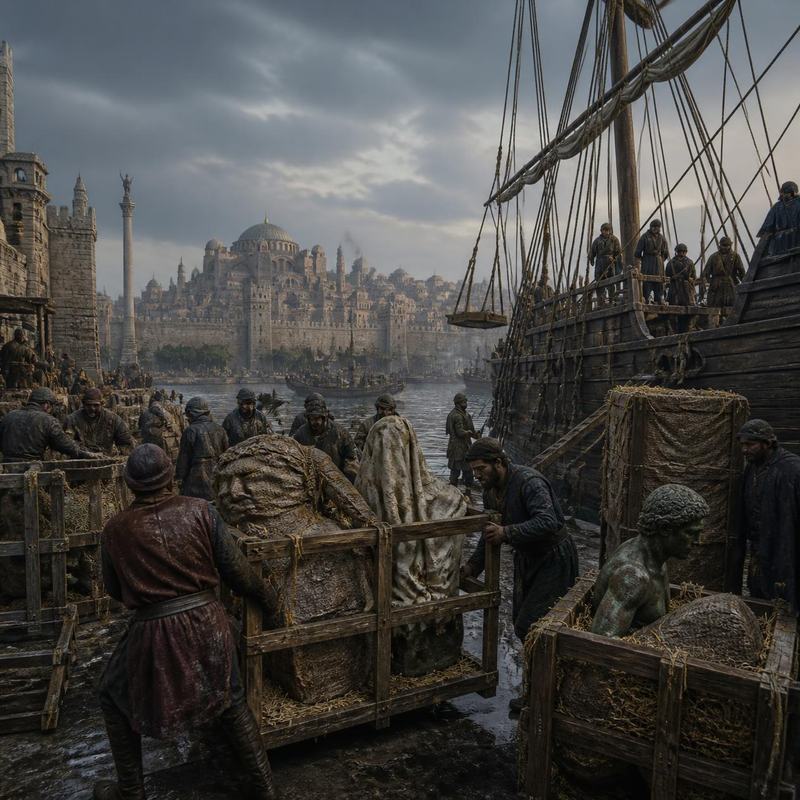
The fate of these horses took a dramatic turn during the Fourth Crusade. What began as a pilgrimage to the Holy Land was diverted, largely due to financial obligations to Venice, leading to the unthinkable: the siege and subsequent sack of the Christian city of Constantinople. On April 13, 1204, the Venetian forces, led by the elderly Doge Enrico Dandolo, breached the city’s defenses. What followed was a devastating period of three days in which the capital of the Byzantine Empire was subjected to widespread looting, destruction, and desecration. Precious artworks, religious relics, and immense treasures were seized, marking one of the largest transfers of art in history. The sack of 1204 inflicted irreparable damage on Constantinople, leaving the Byzantine Empire permanently weakened and setting it on a path towards its eventual fall.
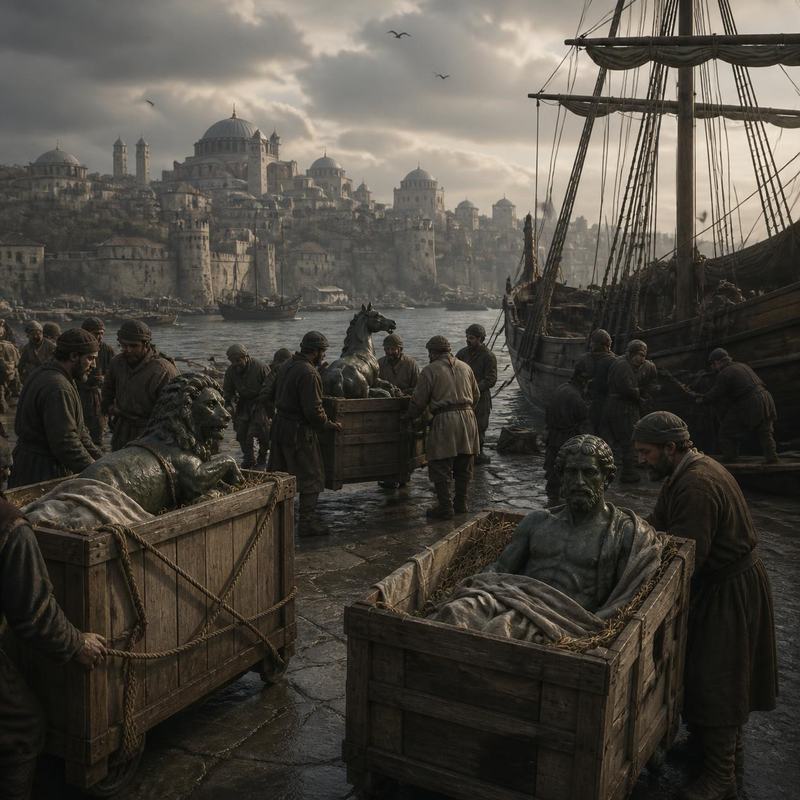
Among the spoils of this conquest were the four bronze horses. The Venetians dismantled the quadriga, severing the horses' heads to facilitate their transport across the Adriatic Sea. Upon their arrival in Venice, the horses were initially stored in the Arsenale, the city’s shipyard, for approximately fifty years. Around 1254, they were installed on the loggia above the central arch of St. Mark's Basilica, a calculated decision that transformed their symbolic meaning. No longer an imperial monument of Constantinople, they became a potent emblem of Venetian power, maritime dominance, and the republic's triumph. The newly added collars on the horses' necks cleverly concealed the cuts made for their removal and transport.
Centuries later, the horses were again displaced by the tides of history. In 1797, following the fall of the Venetian Republic to Napoleon Bonaparte, the four horses were forcibly removed from St. Mark's Basilica. They were transported to Paris, where Napoleon sought to incorporate them into his own imperial iconography, decorating the Arc de Triomphe du Carrousel. This act mirrored Venice's earlier appropriation of Byzantine symbols, as Napoleon aimed to align himself with the grandeur of Rome's triumphal past. However, their stay in Paris was temporary. After Napoleon’s final defeat in 1815, the horses were returned to Venice, reinstated on the façade of St. Mark's Basilica, an act of significant cultural reclamation.
For many centuries, the horses stood exposed to the elements above St. Mark's Square. However, the ravages of time and increasing air pollution took their toll on the ancient sculptures. To protect these invaluable artifacts from further deterioration, the original horses were carefully removed from the basilica's façade in the early 1980s, specifically around 1982 or 1983. They were replaced by exact replicas, which are the ones visitors see today gracing the exterior of the basilica. The original, ancient horses are now preserved and displayed indoors, within the Museo Marciano, accessible to visitors inside St. Mark's Basilica, offering a closer look at their remarkable craftsmanship.
What remains today
Today, the grand Hippodrome of Constantinople lives on as Istanbul's Sultanahmet Square, also known as At Meydanı (Horse Square). While the ancient racetrack and its vast stands are long gone, the expansive open space largely preserves the original footprint of the historic arena. Visitors to Sultanahmet Square can still encounter several significant monuments that once adorned the Hippodrome's central spine (*spina*). These include the towering Obelisk of Theodosius, brought from Egypt, the Serpent Column, originally from Delphi, and the masonry Walled Obelisk. These enduring structures are powerful reminders of the Hippodrome's former glory and its central role in Byzantine public life. Yet, the absence of the four bronze horses from this historic site is a poignant testament to the city's complex past and the numerous treasures it has lost through centuries of change, conquest, and rebuilding.
The story of "The Horses Constantinople Lost" is a narrative woven through millennia, connecting diverse places and people. It speaks to the shifting tides of power, the movement of art as both trophy and symbol, and the enduring human fascination with magnificent craftsmanship. To truly grasp this history, a visitor can begin by standing in Istanbul's Sultanahmet Square, allowing imagination to fill the vast expanse where the Hippodrome once roared with life and where the horses once stood. Then, a journey to Venice, to the Basilica of San Marco and the Museo Marciano, offers the unique opportunity to encounter these same ancient sculptures up close, witnessing a tangible piece of Constantinople’s lost heritage, now safeguarded and celebrated in another iconic city.